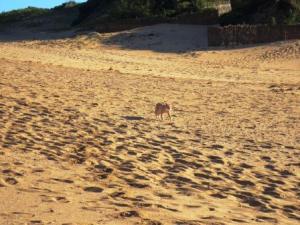
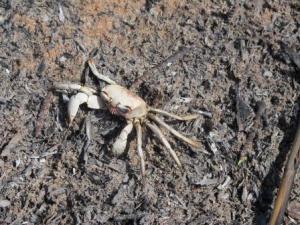
Exposed and anxious, Henry moves swiftly across the dunes
It’s a windy day, bringing in squalls. Yesterday was cold enough to require a jersey and socks for the feet – definitely a sign of winter in this tropical paradise. The sea is turbulent, varying shades of grey as it reflects the mottled sky. At daybreak a bright crescent moon was weaving through the scudding clouds.
I am in a twilight zone, restless yet at peace, anxious but calm, in some sort of indefinable holding pattern, hovering on the threshold of who knows what. The uneasy answer I seek is an age-old cry from the heart of man, “What now? When? Where? How?” Three whiskies in a hotel, we used to say when training salespeople on strategy many eons ago.
I think the biggest fear we have, certainly I do, is that of exposure. I have inherited a young tomcat named Henry, who is full of intrepid bounce and enthusiasm. He likes to follow people, anyone, probably not a good idea, but as he always seems to find his way home I do not to worry too much. On Saturday, however, I took off on my early morning walk and hadn’t gone more than about fifty paces when Henry flew past me at full gallop. I really didn’t want him with me the whole way as I don’t think it’s a good idea to assist in broadening his territory, but have learnt that, unlike canines, cats do not comprehend “Go Home!”
I took the long route to the beach, which crosses a fair amount of exposed dune. The cats are not really happy out in the open, we have Yellow-billed kites, pied crows and other predators of which they are very aware. Undaunted, Henry tailed me until we got to the very edge of the shoreline, at which point his bounce diminished to a slow march. I left him atop a small dune, from which vantage point he watched me go. My last view of him was slinking off to find cover.
Confident that he would find his way home, I was concerned when the day ended and there was no sign of Henry. Muttering to myself that I was not going all the way back to the beach I set off to where I could see where I had last seen him. I began to call, not really confident that he would hear me against the evening wind, in all directions. No response. As I decided to give up and turned for home, I thought I saw a ginger smudge in the gloom at my erstwhile neighbour’s house. Closer inspection revealed nothing but shadows. I gave another couple of bellows, and turned for home again when I was stopped in my tracks by a loud yeowl, and there was Henry belting across the dune!
Is this a lesson, I wonder? When we are out in the open and exposed, do we hole up somewhere until support arrives? Or do we brave the exposure and trust that we will find our way home to peace and sanctuary?
I was led to read Psalm 68 today. There I found these words:
A father of the fatherless, a defender of widows,
Is God in His holy habitation.
God sets the solitary in families;
He brings out those who are bound into prosperity;
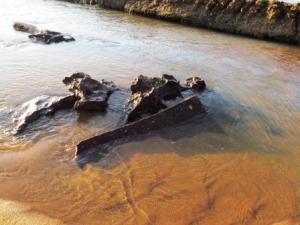
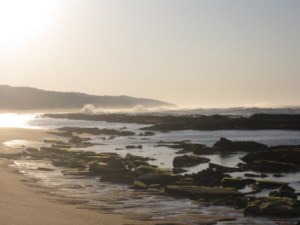
I almost missed him. The waters were swirling around the rocky reef, the tidal pool deep and murky, its surface restless. I was looking for the kingfishers, who were not there. As I turned for home a gap opened in the waters of the pool, and there he was, the rock I dubbed “The Old Master”, at last! Not fully emerged, to be sure, but enough of him for me to recognise the rock that reminds me of an ancient abstract canvas.
I immediately wanted to touch it, to make sure it wasn’t an illusion. There was a channel of water, about a foot wide, similar depth. As I stepped forward and bent down, as if in angry defence of this rock, an aggressive surge of water rushed towards me. I wear *takkies to walk because my feet and ankles need support. Inside those takkies are rather expensive orthotics, so I am wary of getting them wet. Reluctantly I stepped back to avoid the wash.
I did the next best thing, and that was to take a couple of photographs. When I set out on that early morning walk, I had no intention of going up the beach. I was going to follow a road through the woods, down to the beach near where my house used to be, have a swim and home to finish The Book. As I crossed the dune, something drew me to the beach. Once there I realised the tide was on its way out, so there was firm sand to walk on.
The area where The Old Master lives is strewn with rocks of all shapes, sizes, colours. It is as though the reef couldn’t contain itself and spilled out over the beach, making rock pools and secret places for the crabs and coral fish. Each day it is a little different. Every high tide changes the landscape, closing some pools, opening others. This morning the sand around the rocks was smooth, reminding me of icing on a cake. It was a gentle hand that had moved the sand that early morning tide.
The boisterous eddying of water around The Old Master, some fifty metres away, was a jarring contrast. The anomaly intrigued me, and I sat on the sand, watching the antics of the waves, notebook and pencil at the ready. This is what I saw:
The Lord had led me to this sport this morning, so I could understand a profound truth. My journey these past months has been tough. I have a couple of dear friends who are battling in that dark place of the soul that none of us want to go to. I think this lesson is for all of us.
Even as we break free of the cords that bind us, the tides of opposition will swirl around and over us, trying to keep us trapped in isolated solitude. Another errant wave washed over The Old Master, hiding him from view, trying to cover him again with those sands of despair. The power of the Creator prevailed. The picturesque rock continued its ascent into visibility above the waters and the sodden sand, refusing to budge. The waters swirled impotently, their attempts pathetic, weakening, until at last they gave in to the draw of the moon, and subsided.
So too, I am like a rock, I too am Peter, founded on the bedrock of my Saviour’s love. As such I will prevail, I will see the light, and I will shine for all to see, reflecting my Master’s glory. That is our journey. The battle will go on until our time this side of eternity is over. The battle is simply the route to victory, to overcoming whatever impediments we might face that threaten to take us down.
Yesterday I finished writing my first novel. It was a strangely emotional time, and I found myself crying like a baby, sad, happy, relieved who knows why.
As I wrote last week, I sense an ending, and as with all endings there must be a new beginning. It has been a season, a wintry season of discovery and renewal. Through the sadness of irredeemable loss, has a come a quiet joy, a peace, a sense of purpose that beckons me onward.
The lesson of “The Old Master” is never give up. Remain rooted and grounded on your Bedrock, the waters of adversity will recede, grudgingly, and the sun will shine on you again.
Henry is killing a green bean. The last time he killed something it was a mouse. He is throwing the bean up in the air much as he did to the moribund mouse. He is able to fling his conquests a good metre into the air, which I assume is how the body of the rodent landed in the loo, from where I caught Henry trying to retrieve it.
Henry, in case you don’t know, is the new feline addition to my household. He belonged to a young neighbour, who has decided to exchange beach life for city life, and didn’t think Henry would cope with the change. So, Snatch and I now are having to learn to deal with a highly energized young tom, full of testosterone and nonsense. He woke me up at some unearthly hour by collapsing the mosquito net over me. I decide to leave Henry to his chore of decimating the errant green bean in order to see what the world looks like today in the rays of the rising sun.
I have no sooner got the door open, when I hear a voice greeting me in cheerful Portuguese. It is the ever-faithful Jaime, raking what passes for a yard. I hear him approaching, and turn to see him with a huge grin on his face brandishing an orange-tined rake in one hand, and old faithful in the other.
Jaime loves to rake. Before that fateful night back in November when my life was irrevocably changed by the flames of fury that destroyed my home, we had a number of emotional discussions about this penchant of his. It seemed to me that Jaime would be mesmerized by the movement of the sand, and not notice how he was altering the landscape. Thus banks developed where no banks were needed, levels were altered in awkward spots, hard fought for grass would be pulled up, and so on. My one relief after the fire was that the rake would no longer be.
You can imagine, therefore, the look of disbelief on my face when Jaime returned one afternoon, from the ashes of what used to be, proudly hoisting above his head, The Rake! I have just moved for the sixth time since losing my nest, and Jaime has religiously raked every area of beach surrounding every house that I have had the privilege of staying in. Anyone looking for me, simply needs to look for a well raked spot, and you will know I am nearby. So serious is this malady that other guardas are following his example, and we that live here are terrified that we will be raked into oblivion.
None of the afore going withstanding, I felt a momentary pang of something, emotion is too strong a word, as I realised that The Rake is being put away, banished, never to be used again. It is a metal rake, but its labours have been such that its tines are worn and misshapen. It broke in the middle at some point in its life, and carries the evidence of its healing surgery from Jaime, who deftly put it back together again.
I am hoping this is the last move for a while and that the final laying down of The Rake marks the end of this chapter of my life. I am in better shape than The Rake, I’m pleased to say! Still, I hope that the next stage will leave the imprint of an older, wiser, person pruned by God’s hand, to bear the fruit He has planned for me.
Just as I think the beach and the dunes have no further lessons for me, I find there is infinitely more in this microcosm of existence in which I find myself.
There are many cowries that get washed up on this beach, all shapes sizes and colours. One day I found a perfectly formed cowrie, in miniature. It was about the size of my thumbnail. As I marvelled at the intricate attributes in something so small, I noticed that its colours were as yet unformed, neutral greys blending into cream. There were none of the speckled markings and colours that we associate with these shells.
If we look at other small creatures, we find similarities. Lion cubs have spots that they lose as they grow up. Young birds have soft feathers, which are exchanged for a harder more durable covering. We humans lose milk teeth in exchange for serviceable gnashers, our fontanel closes, our hair stiffens. There is a purpose for all these changes that occur during the progression of life. Each one is evolved to ensure the relevant toughness for survival.
As I continued musing over this minuscule cowrie shell, I wondered if there wasn’t more to development than simple survival of the species. Is there not a testing that happens at each stage, or phase, of growth that brings out character?
We had a week of howling gales that arrived in a crash of thunder and flash of lighting and five minutes of such intense wind I thought I would arrive in the Kruger Park unaided by any form of transport other than the wind. Walking the trail through the dune forest afterwards, I realised that the winds had performed a late summer pruning of sorts. Dead branches lay strewn all over the show, a few branches had been broken and it was quite a mess. A couple of trees had been upended too, all I am sure in order to provide firewood for the mussel gatherers! In the old scheme of things these would slowly deteriorate, providing food for myriads of tiny creatures along the way, and ultimately doing its part to restore nutrients to the soil.
Now, however, I see how the broken and in some cases, severely damaged trees are pushing out life. New growth abounds, not only on the trees, but also on the floor of the forest where for a short while more light was able to penetrate the canopy.
I read somewhere once about the beauty of wrinkles, because they described how a life had been lived. There are laughter lines that crinkle the eyes from the times of joy and happiness, the frown lines for the times when lessons needed to be learnt, each one telling a story of hope, of joy, of sorrow, of pain, creating a masterpiece of a life truly lived.
So I returned the young cowrie to the chaffing of the waves. I wonder if by some strange chance, I may find it again. If I do, will it be marked and worn, will it be more beautiful, or more noticeable, or will it gradually disintegrate, unable to stand against the force of the tides, the sand, and the rocks.
The Old Master lies hidden here under sand and water
It was a glorious morning with a contusion of clouds chasing each other along the horizon. The tide was actively going out, the stillness chimerical.
The rocks, unusually devoid of birds, were littered with the shells of eviscerated crabs, and I wondered at the moonlight feast that had taken place during the early hours of the morning. The sea has been unsettled since the floods nearly two months ago, swirling into the beach, changing the shape of things.
The rock I named “The Old Master” has been buried for months and I miss it. Each time I walk on the beach I go to see if by any chance it has been liberated from its sodden grave. I am fanciful that when it comes to light again, I will have moved to the next phase of my journey, possibly excoriated by the sand, but embellished by the experience. It remains steadfastly buried under a beach of sand, added to by a large pool that has developed over its dwelling place. I don’t want to dwell on any portent there.
Wandering back one day the glint of an awkward movement caught my eye. It was a school of small coral fish flopping, wriggling, what passes for jumping in little fish terms, over a rock to get to a deeper pool. It is interesting that for these little creatures, deeper water means safety. How unlike we humans, I thought. They struggle to get in to, we struggle to get out of deep waters. We tend to fight against the tide, they learn to survive within the vagaries of the currents that eddy around them.
A favourite passage of mine is found in Ezekiel 47:1-12. The prophet is shown a vision of water flowing from under the threshold of the temple. The depth of this water increases from ankle, to knee to waist and ultimately Ezekiel is unable to stand in what is now a river. He has to swim or sink. It is generally accepted that this is a picture of the river of life, the living waters that Jesus referred to when speaking to the woman at the well. If we allow ourselves to be immersed in this river we will discover abundant life in the form of sustenance giving trees, multitudes of fish, cleansing and healing.
Our natural inclination when our feet can no longer touch the bottom of a river, or the sea, or even a swimming pool, is to struggle. We vaguely realise that our contending is sapping our strength, but we are unable to relinquish feeble ownership of our mortal will to powers unseen. It is only when we cognitively decide to relax, allow the power of the water to uphold us, that we can see the wonder of the journey.
This week I have been reading of Gethsemane. Do you know that Gethsemane means Oil Press? How appropriate that in this place the weight of our sins was such upon our Saviour that blood was squeezed from Jesus’ body like sweat. I finally understand, I pray, that I am unable to carry the weight of my own sin. The best I can do is confess those sins I recognise, allow the forgiveness of my faithful Father to wash over me. Forgiveness only made possible only by that awful price of atonement wrestled for in an oil press of expiation that dark night in Jerusalem.
Lord, You were broken for me, so as I crouch, broken, at the foot of the cross, Your victory encompasses me. Because of Your love, we can say this passiontide that we are cleansed by Your blood, redeemed by Your death, restored by Your resurrection.
Halleluia!
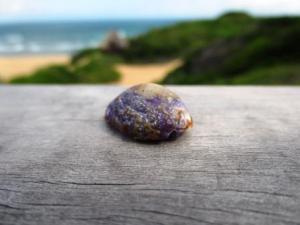
I found this small cowrie on the beach this morning. It caught my attention because it was an unusual purple, adjoined with mottled greys and browns. I didn’t look at it closely when I picked it up, as I was thinking on other things, but I did notice that it felt rough in comparison to how cowries usually feel.
When I eventually got to have a good look at it I saw that it was damaged, its edges broken, the carapace ridged with wear. When I turned it over part of the inside shell was missing. Overall, it wasn’t a prime specimen. I got to thinking how sad that something so young should have been so battered, and carry such scars. Somehow I seem schooled to think that battle scars are only for the more mature, that the young should be exempt.
Such fallacy! Life is life and stuff happens. What counts is how we deal with that stuff, and how we move forward from it. Some people glow from their trials, others buckle under the weight of them.
As I carried on looking at this little cowrie, however, I thought it must have passed through its time of tribulation with flying colours. Purple is the colour of majesty and power, and it was the beauty of its colouring that caught my eye and led me to pick it up. I believe God thought it had done well enough to cloth it with colours of power and make it beautiful in spite of its wounds.
The slings and arrows of outrageous fortune will ever be with us. How we address them occupies a number of themes developed by that Bard of old. Not much has changed with regard to the human condition since that time despite the technological developments that would contradict. Man is ever what he was, facing the same challenges and inward battles, winning some and losing others.
If you are a disciple of Stephen Covey, you will always look for the” win-win or no deal” strategy when faced with adversity. Some are of the “winner-take-all” mindset, others will walk a mile to avoid confrontation. It is this diversity, surely, that makes us so interesting.
Looking at the beauty of this little damaged shell, I find myself praying that when my end is come and my shell is washed up on the shores of life, I too will attract with the colour of my over com
The reports coming out of Mocambique were scarce and varied. For those in the know, if the Limpopo floods its banks in South Africa, then it surely will flood the lowlands of Mocambique.
Vague verbal rumours from residents of a resort near Xai Xai filtered through to me in Swaziland of bad floods in Chokwe, the water levels were higher than in 2000, that Xai Xai and surrounds were on red alert, but in the main there was a careless silence from news agencies. I watched reports on floods in Queensland, fires in Franschoek, snowstorms in Britain and all the while our neighbours were drowning in a sea of muddy water.
After a worrying four days I heard the road was open, with restrictions, and I could return to my base in Chizavane, some 40 kilometres north of Xai Xai. I set off from Swaziland early in the morning not knowing what delays might await me along the way. Maputo was its usual busily chaotic self, needing concentration and patience. Thereafter the EN1 was eerily quiet.
It took me a while to figure out what was different. As I drove through a small hamlet a young lady suddenly jumped out of the shelter of a shop and tried to wave me down. Not something that happens too often on this road. That is when I realised that there were no mini buses. There were also no buses and no trucks. The further north I went the quieter the road became.
Once I passed Manhica, the eeriness deepened because now there were no people. Pools of water blinked in the intermittent sunlight along the side of the road, stretching outwards on both sides. As I got to the cane fields of Chinavane, I began to see the first actual evidence of floods. Roads alongside cane fields were canals, the brick making kilns were covered with tarps, there was hardly a person in sight. At one point I passed a small group of women wading down a road with bundles on their heads, probably making for higher ground.
The contrast when I reached the town of Macia was shocking. People milled around in what seemed like their thousands. The noise was intense, the activity frenetic. I later found out that rural communities had been evacuated to this town. Apparently many of the Chokwe residents were taking shelter here. Once on the other side of the town, however, the emptiness continued.
Finally I reached Chicumbane, the last village before Xai Xai on the bank of the Limpopo floodplain. Here were the first real signs that there was a problem: a military helicopter parked near the football field, two big groups standing listening to the soldiers, a couple of large trucks with huge equipment loaded on them. I knew the point at the edge of the town at which I would see the extent of the floods. In a way the scene matched the picture I had in my head, although the reality was far more overwhelming than I expected.
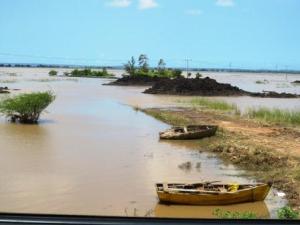
I stopped the car and got out to ingest the magnitude of the flooded plain before me. I have never seen so much water. There was no evidence of any landmark, just electricity pylons standing out of the saturating brown swamp that stretched as far as the eye could see. On the road over the floodplain were two military Bailey bridges, and the few vehicles there were patiently awaited their turn to go over the raised humps of metal.
I passed groups of people on the side of the road, discussing whatever displaced persons discuss. Others were in boats, with bundles of possessions in them. A number of cows were grazing in calm bovine fashion on the edge of the road. I saw a truck half submerged parked next to what must have been the owner’s home. I wondered why he had not heeded the warnings to move.
Xai Xai was like a ghost town. The only places open for business were the petrol stations, and one restaurant. As I reached the tributary that runs through the centre of the city, I saw a number of people standing looking into what is normally a bed of reeds, now a substantial river. As I crossed, a movement caught my eye and I saw a man wading thigh deep down a street that borders the river.
The scene changed dramatically once more when I reached the higher ground of the city. The same mass of urgent humanity that I had seen in Macia, though not quite as intense in number. Until I reached the outskirts of the city that is. A well-known landmark on the edge of Xai Xai, especially to travellers north in this vast land, is a filling station and stop called Petromac.
I stared in amazement at the scene before me. It seemed that every shop in town had erected a stall alongside the road from this point on, and the throngs of people around them were seething and vibrant. The mini buses had established their station on the right, and business, it seemed, was booming. It was an amazing atmosphere, where people who are used to adapting to the vagaries of their land, were getting on with their lives without, it seemed, any resentment or anger. It was almost like a carnival, and I wanted to get out and be a part of it and drink from the positive energy of these remarkable men, women and children.
As I travelled the last 40 kilometres to where I turn off at Chizavane, I wondered at the strength and resilience of these Mocambicans. All I had seen along this six-hour journey, was communities dealing with a problem they had dealt with many times before in a mature and logical manner. There was no wailing, no standing on the side of the road begging, there was just a getting on with the business of living.
Back at The Beach as we call it, a neighbour tells how he watched a man being swept downstream, hanging onto the tail of his cow. In his desperation to save his animal he couldn’t heed the calls of those on the banks to let go and swim to the bank. No one knows if either of them made it to safety. There are reports of the river at Chokwe being 11 metres higher than normal, some 10 kilometres in width. The mind grapples with the vision of this, and the impact on humans, animals and land.
The months to come will be hard. Already there are fears of cholera and dysentery outbreaks. As I neared the bridge over the Limpopo, I smelt from the higher ground that was emerging from the receding water, the unmistakable aroma of rotting flesh. Chokwe, hardest hit by the floods, is a major vegetable producing area of Gaza province, so fresh produce will be hard to come by. The repairs to roads, bridges and homes are set to be in the billions.
The world is silent. Are we bored with floods in Mocambique? Are there too many natural disasters in this world of ours, that another just dulls the senses?
I am indignant, because this is a generous nation. I remember when Cyclone Damoina hit way back in the early eighties, out of Swaziland and South Africa, Mocambique was the most devastated. Yet the government of that day sent a donation of cement to Swaziland to help it rebuild its infrastructure. I am humbled each week when the man who works as my guard comes back to work bearing gifts of cassava, sweet potatoes, pawpaws whatever, but it is always way more than I need. They are always willing to lend a hand when needed.
It is as well that the citizens of Mocambique have t resilience developed over many decades of hardship to overlook the lack of generosity of others towards them and to weather the storms that frequently overflow them.
Even as the rains continue, they do not cry and wail for someone to come to their rescue. They do not blame their government and the world at large for what they are going through. They get up as soon as the rain stops and they start doing what needs to be done to get everything running again as soon as possible.
There is a lesson to be learnt from these people on the eastern side of southern Africa. It is a lesson of humanity, of the value of a positive attitude, with no sense of or demand for entitlement, only of living each day to the best of your collective ability.
I love this time of the year.
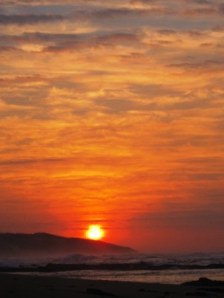
Each day begins with a determined resistance to getting out of bed to watch the sun make his strategic appearance because it happens really early. The first colours of the dawn start streaking the sky around four am. After about twenty minutes of trying to ignore what is happening outside my window, I have no choice but to get up, fling open the door and rush out to be awed by what I see.
It is such a performance and each day is different. The colours change from burnt orange to delicate pink to shimmering gold and everything in between. Some mornings the colours are more dramatic, other times they are more subtle. I can almost see God smiling as he operates the machine that makes this kaleidoscope, His delight in the show He is orchestrating as much as His delight in astounding us.
The build-up to the actual appearance of the sun is quite spectacular, and one is stretched waiting for the moment of that first glimpse of the orb above the horizon. You only need to glance away and you can miss it. Once that thin line of golden light appears on the horizon, the ascent is very quick.
There are mornings when I fancy the pomp and ceremony accompanying this daily ritual to be quite arrogant. Other times, the sun almost seems shy about its entrance onto the heavenly stage. I can quite see why the ancients, and I suppose some still today, deified the sun as there is a sense of majesty, a feeling of awe that accompanies this splendid arising.
If we return to the creation story in Genesis, it is written that God made this great light to rule over the day, and the lesser light to rule over the night. So the sun is imbued with a certain authority and has a duty to perform. Why is that we humans ever want to worship that which we can see, and spurn so willingly that Creative Force behind the created that we are unable to see. We seek for that which our finite minds can control, loth to let go and give praise to a Heavenly Being that seems distant and unapproachable. I love the thought that my heavenly Father actually does this for me, in fact He does it speciallyvery simply because He loves to see my delight at the show He puts on for me each day.
Isaiah 62 v4, God says He delights in us. In verse 5 He says He rejoices over us much as a bridegroom rejoices over his bride. Again in Psalm 149 verse 4 the psalmist says “For the Lord takes pleasure in His people; He will beautify the humble with salvation.” What an awesome thought! That the God of all takes time each day to delight His children!
It is not just at the beginning of each day either. The whole performance is repeated at the end of the dayjust in case we miss the first show!It is easier to be aware of all this when you are in an environment that is more rural, away from the madding crowd as it were.
Sundowners are quite a tradition here at the beach. A couple of times a week we make time to meet at some strategic spot simply to enjoy the sunset, catch up with each other, and wind down the day together. It is a peaceful time, a time of companionship, a happy time.
The other Saturday my neighbours invited me to join them in farewell sundowners for their guests from Sweden who were leaving the following day at the lake a short distance behind the dunes of the beach. What an extraordinary evening that was! The beginning of the sunset was really quite ordinary. After a while, however, we noticed that the clouds opposite where the sun was going down were tinged with an amazing pink. Then it happened. The whole scene changed and rays of pink and gold and orange and all sorts radiated out – the entire sky was involved. Swirls of cloud illuminated with different hues, changing every few moments. As if that were not enough, it was all reflected in the waters of the lake, so we felt as though we were in a 3D experience. The Swedes among us said it put them in mind of the northern lights.
A natural phenomenon caused by some dust particles in the sky I am sure would be a logical explanation for it. I prefer to think it was God giving the holiday-makers a good send off and a lovely start to their new year.
One day while walking on the beach I noticed a woman fishing from the rocks. Nothing remarkable you might think, until you understand that here this is a predominantly male preserve. She inspired the following:
She stands unmoving in the spray
This woman of Africa
She is immutable, she is steadfast
The waves are relentless
Pounding impotently against the lava of old
The woman is timeless as she is bold
She is the rock on which she stands
As they reflect the amber depths
Of unplumbed, undefined emotion
Her journey is an unbroken step
Walked with stoic endurance
A life unremarked and unnoticed
It will end as it began
On a palette of reeds
In an unfloored hut
Dust to dust, ashes to ashes
Living to newly departed
Still the waves keep coming
The rocks stand firm
Her timelessness slowly fades
Until another stands in her place
The explosion, though expected, was stultifying to the senses when it came. The fireball cannoned high into the night sky, a dervish swirling in the wind. The extraordinary beauty of the highway of bright orange ashes that was laid, against the terror of what else might ignite somehow fitted the tragedy of the fire that razed my house to the ground that windy November evening.
This is my tribute to the heroes of that night. The list is long, and I pray comprehensive. I would ask that you be inspired by their generosity of spirit, their humanity and their compassion without which I would not have survived the pain of loss as I have.
Maggie and Barbs, you were first on the scene, you brought a fire extinguisher, you made the calls, and then you stood by me, and held me up. As if that was not enough, you then wrapped me in love and care and took me home and looked after me as if I was your own.
Shane, you came running, and you did not stop until you were certain every house was safe. You braved the heat to make sure any remains would be safe, and helped me find some of what I thought was lost.
Carlos, what a star you were, taking control, quietly and efficiently sorting out all the technical problems to ensure the damage was limited. You tried to lead me away, to leave the ruins and move forward. May that be your portion, too.
Rio, you blessed my heart so much with your concern, your love and your consideration! I wore your socks today….and wondered how one so young could be so aware of a simple need of mine: that of proper walking shoes!
Monika, your voice of encouragement and certainty that this was not the end has come back again and again to reassure me. You are a tower of strength and support.
Jacques, my one “young ‘un”, bless you man of God for the comfort of your arms around me, your wanting to shield me from the sight, offering to “look” for me. To Sonia, my other “young ‘un” for your prayers and words of encouragement, your gifts of much-needed items that helped keep things normal
Peet, your quiet strength, the power of the words you spoke to me on the dune that night touched the inner core of my being with hope. You reminded me that no matter what is going on around us, we can stand secure, no matter how broken we are there is hope, for no reason other than we know our God! The prayers you have prayed, the bread we broke, the strength you imparted, thank you and may God continue to use you as His own.
Erma who, in the midst of leaving Chizavane for a much-needed break, thought to leave clothes for me, and unhesitatingly parted with new items that I needed so badly.
Tomaz, for your foresight in dismantling the stairway so the fire had no route to spread, for your ongoing, reticent concern that I am coping – I will yet eat of your crayfish!
Jaime and Alda, you are such faithful workers. Jaime, you have never once mentioned all that you lost in that fire, or asked for compensation. You worked like the Duracell Man that you are in the hot sun to clear the wreckage so the scar could heal. Alda, you too, never complained about your loss. You have adapted to our new circumstances, and just got on with what needs to be done.
My neighbours, Kevin and Cathrien, Ronnie and Sandrine, Louis and Frederica, and Mayke, how do I thank you all for the supplies you bought, and Kevin took the time to deliver from Maputo. The thoughtfulness of each little detail, down to making sure I had the tea I like, the toiletries, the journal, broke my heart while making it rejoice! Zara, your gift for Snatch has touched many people.
John and Jane for tears together, for clothes, for thinking of and providing the cash I needed to get my emergency passport and to get back to Swaziland when I couldn’t think for myself.
Mathe for making sure I could get papers, Senhor Cou for being so patient with one who tries you, Gloria for your support and prayers, the residents of Chizavane who stopped for a minute to pray for us, thank you.
Before I leave Mocambique for Swaziland I am sure there are those of you wondering: what of Scott? He is so huge that I cannot include him here, he has to stand alone. He is the only person who hears the cry of my heart before the words are formed in my mouth, and the gratitude I feel is deeper than words can say.
A full week after the fire I had all the documents I needed to travel to Swaziland. It was an exhausting week, and I only realised how drained of energy I was when I couldn’t keep the car on the road. So I rested for two days, and then made the heartsore journey to the land of my birth.
More love and support awaited me. The calls had not stopped coming since the news of the fire got out and now it was time for the hugs, telling the story over and over, loving and being loved by those who have ever been friends.
Barry and Viki, as always, first on the phone, offering cash as they were too far away to do anything else, to do whatever I needed doing if it was in their power to do it. Then the books, the offering you collected, the notebooks, pens, soaps that I love, thank you.
Martie, you offered refuge, you offered help, I just had to let you know what I needed.
Helen Ward and Potter’s Wheel your donation was more than generous and will play an important role in getting me on track with writing again.
Carlie, you and Jim opened your home, your friendship is boundless, and you went into overdrive to make me fashionable again! You made my Christmas Pud, but most of all you listened, even if you did get a bit bored and dump me in the pineapple fields at the last!
Dottie, you gave me the best gift – that pamper session was what I needed to get fully back on my feet again.
Wendy, my face and I thank you for your gift of the tools of our former trade.
Caroline, your case of clothes produced an outfit that made me belle of the Thanksgiving ball at the beach, your thoughtfulness in giving me a devotional that I so needed, the towels, soaps, you are a treasure.
Estelle, you and Hannes went the extra mile as you always do – my first new book and such a clever one at that! I will use your love gift to replace my bible and concordance.
Joan, Jean, Margaret and Berdien, you have no idea how much your calls and your support meant, how good it was to hear from you.
Dick and Jenny, Susan for your gift, which helped, replace much-needed supplies.
Mathew, thank you for thinking to ask if I was unhurt, Bev for your prayers and words of encouragement, Kirsty for keeping tabs on the progress down here.
And then to my sons, Dwayne and Mark, to Vanessa, who are my support team, my advisors, my reasons for carrying on.
To each one of you, may the God of my sufficiency bless you abundantly according to His riches in Christ Jesus.